

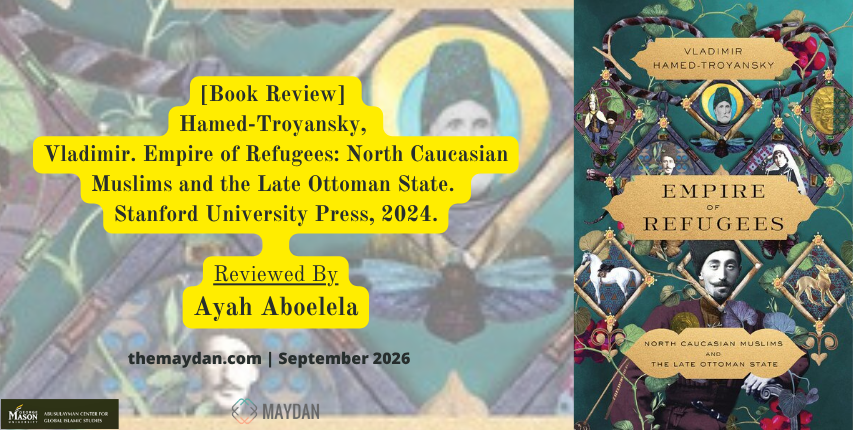
This review was first presented at the 2025 Graduate Student Book Review Colloquium on Islamic and Middle Eastern Studies organized by the Maydan/ AbuSulayman Center for Global Islamic Studies at GMU on December 18, 2025.
Between 1864 and 1914, correlating to the Russian conquest of the Caucasus and World War I, about one million North Caucasian Muslims left Russian territories due to war, ethnic cleansing, and religious persecution. In Empire of Refugees, Vladimir Hamed-Troyansky explores this process, tracing the migrations of Muslim refugees from the Caucasus to the Ottoman Empire throughout this half-century. He uses two complementary approaches: bottom-up, by considering the perspectives and experiences of refugees through private collections, family papers, refugee petitions, and oral history interviews of the descendants of Caucasian refugees; and top-down, by revealing the Ottoman state’s strategies in categorizing, settling, and managing refugees through archives in Turkey, Bulgaria, Georgia, Jordan, Russia, and the United Kingdom. His book especially focuses on the Balkans, Anatolia, and Transjordan—three places where North Caucasian refugee resettlement was concentrated.
This satisfyingly organized book is divided into three sections, parallelizing the stages of refugees’ journeys: migration, resettlement, and diaspora or return. In Part 1, refugees’ experiences of migration are examined alongside the Russian and Ottoman policies that shaped them. A major argument is that in the last half-century of the Ottoman Empire, the Ottoman state created a refugee regime, defined as “a set of principles, norms, and procedures governing the acceptance and resettlement of refugees” (57). Contrasting Ottoman refugee policy with twentieth-century European, secular refugee policy (which receives far more scholarly attention), Hamed-Troyansky argues that the concept of hijra – Islamically-inspired and validated migration – was central to understandings and justifications of migration by both the refugees and the state. Thus, he shows that on the one hand, North Caucasians compared their migration with that of the Prophet Muhammad ﷺ and, on the other, the Ottoman refugee regime, spearheaded by the Refugee Commission, fashioned the empire as a refuge for Muslims displaced in the era of European imperialism.
While the rhetoric of hijra partly corresponded to Sultan Abdulhamid II’s pan-Islamist visions, the state had pragmatic goals for resettlement strategies. One, it wanted to strengthen the economy by settling refugees in the countryside, expecting an increase in agricultural production and taxation. Two, the state used refugee settlement as part of its civilizing mission to sedentarize, tax, and solidify control over nomads. As refugees settled in what had been traditionally nomad-controlled land, especially in Anatolia and Transjordan, they used the Ottoman Land Code of 1858 to register land and claim rights to it. This created competition with nomads, who were pressured to officially register and settle in their lands. Three, the state attempted to settle Muslim refugees in frontier regions to change demographic ratios, preceding the demographic engineering that would shape much of the twentieth century. By this sectarian logic, the Ottoman state hoped to quell nationalist and anti-Ottoman sentiment from Greek and Armenian populations. Hamed-Troyansky argues that by WWI, the state’s goals to alleviate the suffering of Muslim refugees coalesced with its decision to annihilate other non-Muslim communities, leading to the Armenian genocide.
Part 2 studies the aftermath of resettlement, and it is here that Hamed-Troyansky’s bottom-up approach is most impressively employed. The three chapters here uncover the outcome of refugee resettlement in the Balkans, the Levant, and Anatolia, respectively, and each is framed by stories of specific refugees. This way, we are introduced to refugees in the Balkans who gave up farming to join irregular armies, in the Levant who negotiated with neighboring nomads, and in Anatolia who petitioned the state for funding mosques and schools. Ultimately, Hamed-Troyansky argues that state strategies, local circumstances, and refugees’ decisions all affected the outcomes of resettlement, which varied greatly.
In the Balkans, covered by Chapter 3, the state settled North Caucasian refugees in the 1850s-1860s in ethnically and religiously mixed villages and did not provide enough financial support. This resulted in many refugees giving up on farming enterprises, turning to banditry, and joining refugee militias, which were created by the Ottoman state to suppress Bulgarian nationalist movements. This led to sectarian clashes with local communities and stoked anti-Ottoman nationalist uprisings.
So, while the Ottoman loss of the Balkans is often explained through geopolitics, Hamed-Troyansky shows that refugee resettlement played a major role in expediting the end of Ottoman rule over the Balkans.
By contrast, refugee resettlement in the Levant, which was concentrated in the 1870s-1880s, was largely successful for multiple reasons. For one, Ottoman officials learned from their mistakes in the Balkans and allowed refugees to choose where to settle. Many settled near families and friends and established new, mono-ethnic refugee villages. The largest, most successful, and longest-lasting of these villages was Amman, which is the focus of Chapter 4. Many refugees also took the initiative to establish good relationships and treaties with Bedouin tribes, which improved the security of travel through Bedouin territory and increased economic exchange between Bedouins and settled groups. While Samuel Dolbee, Eugene Rogan, and Nora Barakat have studied Bedouin roles and experiences in late Ottoman reform, Hamed-Troyansky adds the valuable perspective of refugees and their interactions with Bedouins.
As in the Levant, the state strategically settled refugees along the nomadic frontier in Anatolia, especially around Uzunyayla, as detailed in Chapter 5. While this story was told from the perspective of Anatolian nomads and locals in Chris Gratien’s Unsettled Plain, it is told in this book from the perspectives of refugees. Although North Caucasian refugees in central Anatolia fared better than in the Balkans, they were not as economically successful as their kin in the Levant. In the Levant, refugees benefited from the Hijaz Railway, which connected many villages between Damascus and Amman and allowed trade to thrive. As there was no railway in central Anatolia, nor was there a trans-Anatolian highway, it was difficult for refugees to export their agricultural produce. Thus, state financial support is, in Hamed-Troyansky’s view, the most important deciding factor in the economic success of North Caucasian refugee settlements in the Balkans, Levant, and Anatolia.
But the question that was raised remains unsatisfactorily answered: why did the Ottoman state invest more in the Levant than in Anatolia and the Balkans? While Hamed-Troyansky explains that officials assigned to the Levant learned from the disastrous outcomes of the Balkans, he does not explain why the state chose to financially invest more in refugee villages in the Levant than in Anatolia. I wonder if the answer may lie in the Hajj, which Hamed-Troyansky frequently emphasizes as an important factor affecting refugee stories. Refugees often performed the Hajj as part of their journeys, and some used annual pilgrimage caravans to send letters to friends and family from whom they were separated. We know from scholars like Michael Christopher Low, Lale Can, Mostafa Minawi, and Selim Deringil that the Ottoman state increasingly prioritized the Hajj in the decades leading up to WWI, and this included the construction of the Hijaz Railway through the Levant. Perhaps, then, the railway’s existence in the Levant and lack thereof in central Anatolia should not be seen as a cause of economic success or failure, but rather a symptom of the state’s priorities.
In Part 3, Hamed-Troyansky traces the ways North Caucasians either built their new lives in their new homes or returned to the Caucasus. Chapter 6 studies the formation of diasporic networks and communities as refugees practiced communal law, printed newspapers, invested in education, and partook in activism (which was often against abolition, as an increase in Circassian slavery in Ottoman territory was an unfortunate side effect of the refugee crisis). Chapter 7 concludes by tracing the stories of refugees who returned to Russia, challenging both Ottoman and Russian laws and restrictions on their mobility. This way, Hamed-Troyansky studies Russian migration policy towards Muslims and builds on Akram Fouad Khater’s point that migration studies rarely include return migration in their scope.
Because this book is so rich and multilayered, it reveals several themes that could be elaborated upon as studies on their own. One theme I am particularly interested in is the role of environmental actors. Although Hamed-Troyansky does not systematically study non-human actors as he might have if he were writing an Environmental History, he keeps them present throughout the book, showing how diseases (typhus and cholera), landscapes (land fertility and water sources), and climates (drought and extreme cold) all shaped refugee experiences and the extent of their successful resettlement
. Other secondary themes include the Hajj, Circassian slavery, the Armenian genocide, and literary production—all of which could be further explored for their entanglements with migration history. Finally, it is briefly mentioned that Muslim refugees to the Ottoman Empire came from many different places, including Crimea, the Balkans, Crete, Central Asia, North Africa, and Afghanistan; I am curious about how their experiences and state policies regarding them compared with those of North Caucasians.
Today, a time of several parallel refugee crises, it is more important than ever to understand the history of refugee crises. This book not only allows us to understand the successes and failures of refugee policies, but it also prompts us to empathize with historic figures facing multiple forms of imperialism. Written in clear and concise prose, Empire of Refugees is made even more accessible as each chapter is framed by an individual refugee, revealing larger dynamics through the writings and experiences of the men and women who witnessed and shaped them. I expect the book will significantly influence the fields of Ottoman, Global, and modern Middle Eastern History in the years to come.