

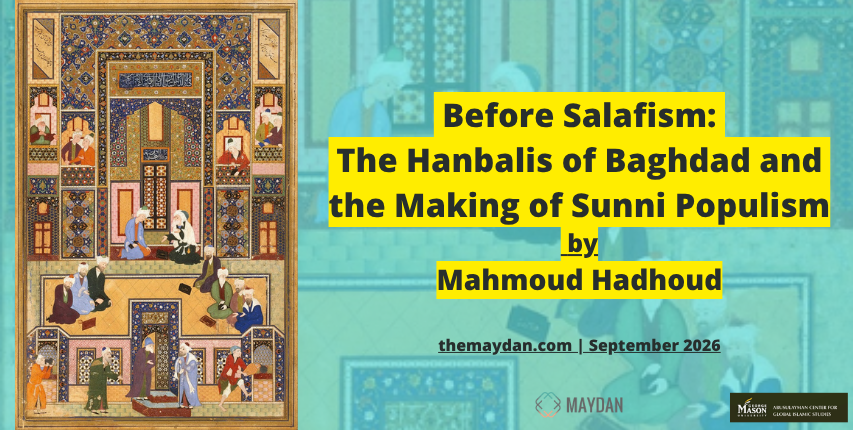
In his Tabaqat al-Hanabila, Ibn Abi Ya‘la describes the extraordinary growth of al-Barbahari’s influence. Al-Barbahari was the leading Hanbali figure in Baghdad at the beginning of the fourth Islamic century. According to Ibn Abi Ya‘la, his following became so large that once, while al-Barbahari was passing through the western side of Baghdad, he sneezed. His followers responded by invoking God’s mercy upon him, and their voices rose so loudly that the Abbasid caliph al-Radi heard the commotion from his palace balcony[1].
There is an obvious element of exaggeration in Ibn Abi Ya‘la’s account. Yet the historical irony becomes striking when, many centuries later, the Indian scholar Abu al-Hasan al-Nadwi invoked the same image to describe Hassan al-Banna’s influence over the Muslim Brotherhood. During a visit to Egypt, al-Nadwi reportedly remarked that if Hassan al-Banna sneezed in Cairo, his followers in Aswan would bless him.
Although the Muslim Brotherhood is distinct from contemporary Salafism, the experience of the Hanbalis of Baghdad in the fourth and fifth Islamic centuries—the tenth and eleventh centuries CE—offers a telling historical analogy for contemporary Salafism, and an early example of the emergence of a populist religious movement capable of mobilizing the urban masses (al-‘amma) around a strict religious and moral ideology, challenging established religious authorities and seeking to recover an imagined ideal religious past.
Baghdadi Hanbalis helped formulate mature iterations of doctrines of Ahl al-Sunna that would later find purchase in Hanbali revivalism and modern Salafi theology. They also fought the Ash‘aris over the meaning of Sunni orthodoxy and who had the stronger claim over it. The later history is not a straight line: modern Salafism itself is a historically contested category, as Henri Lauzière has emphasized. Still, the revival of medieval Hanbali authorities through Wahhabism and later Salafi currents makes the earlier Baghdadi experience more than an antiquarian episode. Cole Bunzel’s history of Wahhabism, for example, traces a central strand of Wahhabi doctrine through Ibn Taymiyya. That being said, the resemblance between the Hanbalis of Baghdad and contemporary Salafism extends beyond the doctrinal continuity that links them.
The significance of the Baghdadi Hanbali experience for understanding later revivalist movements lies not in a simple genealogy but in their structural resemblance: the organization of a religious constituency, the transformation of doctrinal boundaries into social identities, moral intervention in public life, and an unstable relationship with political authority. The history of the Hanbalis of Baghdad thus intersects directly with the sociology and politics of religious populism.
The Rise of the Hanbalis in Baghdad
Ahmad ibn Hanbal died in 241 AH/855 CE without leaving behind an organized Hanbali school of jurisprudence. What he did leave was an enormous body of answers to questions posed by students and followers, many of whom collected this material in works known as masa’il. Abu Bakr al-Khallal (d. 275 AH/889 CE) gathered, classified, and organized these scattered reports, helping transform Ahmad’s legacy into a coherent school of law—a process reconstructed in Christopher Melchert’s study of the formation of the Sunni schools of law.
The social embodiment of that legal school emerged most clearly under al-Hasan ibn ‘Ali al-Barbahari (d. 329 AH/941 CE). Al-Barbahari represented an unusual model of Hanbali leadership. Unlike scholars whose activity centered primarily on teaching and writing, his influence extended into social mobilization, with attempts to impose religious and moral boundaries upon everyday urban life. Around him developed a network of preachers and followers with a genuine capacity for street mobilization. The Hanbalis acquired a broad popular base in Baghdad, particularly on the western side of the Tigris and in districts such as Bab al-Basra. Livnat Holtzman’s overview of early Hanbalism describes how Hanbali activism grew into a formidable urban political and social presence.
One of the earliest conflicts revealing the social formation of Baghdadi Hanbalism was their confrontation with Muhammad ibn Jarir al-Tabari (d. 310 AH/923 CE) during the final years of his life.
One of the earliest conflicts revealing the social formation of Baghdadi Hanbalism was their confrontation with Muhammad ibn Jarir al-Tabari (d. 310 AH/923 CE) during the final years of his life. Al-Tabari, widely regarded as one of the greatest authorities on Qur’anic exegesis and history in the Islamic tradition, was an independent jurist. In his Ikhtilaf al-Fuqaha’, a text meant to summarize the differences between Sunni Islam’s primary schools of law, he discussed the doctrines of Abu Hanifa, Malik, al-Shafi‘i, and al-Awza‘i, but did not count Ahmad ibn Hanbal among the founders of the major legal schools. At that moment the Hanbali school had not yet fully matured as an independent legal tradition. Accounts of the dispute report that al-Tabari regarded Ahmad primarily as a scholar of hadith rather than a jurist in the sense relevant to his book. For the biographical context, see Elton Daniel’s study of al-Tabari.
The conflict was not merely jurisprudential. It also involved the highly sensitive theological question of the maqam mahmud, the “praiseworthy station” mentioned in Qur’an 17:79. Among traditionalists in Baghdad, a report attributed to Mujahid was circulated according to which the phrase meant that God would seat the Prophet beside Him upon the Throne. Al-Ṭabarī, by contrast, identified the maqām maḥmūd primarily with the Prophet’s eschatological intercession (shafāʿa), which he regarded as the interpretation best supported by the Prophetic reports. Significantly, however, he did not dismiss Mujāhid’s interpretation as inherently impossible; after preferring the intercession reading, he maintained that the claim that God might seat Muhammad upon the Throne could not in itself be rejected on either transmitted or rational grounds. The controversy became an emblematic issue for Baghdadi Hanbalis. Holtzman’s study of anthropomorphism in medieval Islam shows how the Mujahid report acquired exceptional importance in Hanbali traditionalism.
Al-Tabari’s opponents were enraged by his position. Reports describe his house being pelted with stones and inkwells, with police protection needed for his residence. The anger did not end with his death, with some accounts noting he had to be buried at night because of fears that a public funeral would provoke disturbances. The precise relationship between al-Tabari’s own exegesis and the later polemical stories is debated, but the episode reveals how questions of jurisprudential legitimacy and theology could become issues of collective identity and urban power.
The dispute over the maqam mahmud continued after al-Tabari’s death. Under entries for the year 317 AH/929 CE, medieval chronicles record a conflict in Baghdad involving followers of Abu Bakr al-Marwazi (d. 275 AH/888 CE), one of Ahmad ibn Hanbal’s closest disciples, and other sections of the population. The followers of al-Marwazi maintained that the verse meant that God would seat the Prophet with Him upon the Throne; their opponents interpreted it as the Prophet’s great intercession. The episode became violent. Modern treatment of the tradition and the politics surrounding it can again be found in Holtzman’s discussion of the maqam mahmud controversy.
Al-Barbahari: The Hanbalis’ Guide
With the rise of al-Barbahari, Hanbali social power moved beyond theoretical disagreement. For some of his followers, the obligation to “command right and forbid wrong” became a form of direct intervention in the everyday life of Baghdad. Reports describe traditionalist activists breaking into houses to pour out wine, smashing musical instruments, confronting female singers, monitoring relations between men and women or youths, and intervening in markets and commercial transactions. Susanne Olsson’s study of traditionalist “forbidding wrong” in Abbasid Baghdad places these practices within the social and political conflicts of the tenth-century city.
Hanbalism thus became, for part of its constituency, a social movement seeking to impose a strict moral order upon the public sphere. The same activists who opposed theological innovation also acted upon urban space itself, treating the streets, homes, markets, and forms of entertainment as arenas of religious discipline.
This confrontation became particularly visible in 321 AH/933 CE, against the background of a political struggle between the Abbasid caliph al-Qahir bi-llah and the military commander ‘Ali ibn Yalbaq. The struggle formed part of the longer erosion of effective caliphal power and the increasing political weight of military commanders.
After ‘Ali ibn Yalbaq acquired effective control of the government, al-Qahir or forces loyal to him spread the allegation that Ibn Yalbaq and his secretary al-Hasan ibn Harun intended to order the cursing of Mu‘awiya ibn Abi Sufyan from the pulpits. The rumor provoked popular unrest in Baghdad. Ibn Yalbaq ordered al-Barbahari’s arrest. Al-Barbahari went into hiding, while several leading members of his circle were arrested and some were exiled to Basra. Yet al-Qahir was ultimately able to exploit the unrest to rid himself of Ibn Yalbaq and have him killed.
The episode illustrates a recurring pattern. The Hanbalis could function as an autonomous popular force, as opponents of the state, or as an instrument that factions within the state sought to mobilize against their rivals. Their political position was therefore never reducible to simple loyalism or rebellion.
The Hanbalis could function as an autonomous popular force, as opponents of the state, or as an instrument that factions within the state sought to mobilize against their rivals. Their political position was therefore never reducible to simple loyalism or rebellion.
Tensions reached a peak in 323 AH/935 CE, when Caliph al-Radi took severe measures against al-Barbahari’s followers after their intervention in public life had grown increasingly aggressive. A caliphal decree accused them of imposing beliefs upon others, assaulting people, and provoking disorder. It was in this setting that one of the most violent episodes associated with Baghdad’s sectarian conflicts occurred: the burning of markets in al-Karkh, an important commercial district of southwestern Baghdad and a major center of Imami Shi‘ism. After the arrest of one of al-Barbahari’s followers, a group identified as Hanbalis set fire to the market of al-Karkh. The flames spread through extensive parts of the commercial district. One account reports the destruction of forty-eight rows of shops and the deaths of men and women; other markets were also damaged, and the authorities eventually compensated some of those affected[2].
Al-Radi’s problem with the Hanbalis was not limited to their conflict with the Shi‘a. His decree condemned their intrusion into people’s lives, their attempts to impose theological doctrines by force, and their role in provoking unrest. The authorities ordered al-Barbahari’s followers dispersed, with some imprisoned and others exiled.
The movement survived these attempts at containment. In 327 AH/939 CE, a confrontation regarding the peoples’ celebrations of mid-Sha‘ban occurred, with the Hanbalis opposed to the widespread popular celebrations. Several Hanbali leaders were arrested while al-Barbahari remained in hiding. In 329 AH/941 CE, Hanbalis reportedly attempted to attack a Shi‘i mosque that had been rebuilt. Al-Barbahari died in hiding in the same year. His death can be seen as the end of a distinctive phase in the history of Baghdadi Hanbalism: the era of the charismatic popular leader capable of large-scale street mobilization. Yet the networks created during that period survived. Hanbali scholarly families, mosques, preachers, and a substantial popular constituency continued to play an important role in Baghdad throughout the following century.
Political Transformation and Social Resistance
In 334 AH/945 CE, the Buyids entered Baghdad and established political control over the Abbasid caliphate. Their regime patronized Shi‘i institutions and Mu‘tazili scholars, both doctrinal rivals of Hanbalism. The Buyids do not appear to have pursued a systematic policy of active repression against the Hanbalis. Nevertheless, Hanbali activists could no longer exercise the same kind of social power under a political order generally unfavorable to them.
It was in this environment that major Hanbali scholars consolidated the theological and legal tradition: Ibn Batta al-‘Ukbari (d. 387 AH/997 CE), al-Hasan ibn Hamid al-Warraq (d. 403 AH/1013 CE), and later Qadi Abu Ya‘la (d. 458 AH/1066 CE). Through figures such as these, Hanbalism developed from a predominantly anti-kalam posture into a more elaborate theological system with its own texts, categories, and doctrinal formulations. Works such as Ibn Batta’s al-Ibana and the creedal text Sharh al-Sunna attributed to al-Barbahari set out what a follower of the Sunna should believe and what should be rejected from the doctrines of the Jahmiyya, Mu‘tazila, Shi‘a, and practitioners of speculative theology.
The most important political transformation of the Buyid period, however, came through the religious politics of the Abbasid caliph al-Qadir bi-llah, who ruled from 381 to 422 AH/991–1031 CE. The caliphate remained militarily and politically constrained by Buyid power while also confronting a major challenge to its legitimacy from the Fatimid caliphate in Cairo. Al-Qadir attempted to recover part of the caliphate’s authority through the religious sphere. A series of doctrinal declarations associated with the Qadiri creed (not to be confused with the Qadiri Sufi tariqa) attacked Mu‘tazili, Isma‘ili, and certain Shi‘i doctrines and employed traditionalist language that, in certain important aspects, resembled Hanbali positions. The composition and political function of these declarations is examined in Livnat Holtzman’s recent study of al-Qadir and the Qadiri creed.
The significance of the episode lies not simply in the content of the creed. The caliphate was attempting to produce religious authority in a political environment in which its direct coercive power was limited. Hanbali traditionalism could therefore become politically useful as one language through which Abbasid legitimacy was re-asserted against rival doctrinal and dynastic projects.
During the fifth Islamic century, Qadi Abu Ya‘la ibn al-Farra’ (d. 458 AH/1066 CE) emerged as one of the central figures in the maturation of Hanbalism. He represented a different model from al-Barbahari. If al-Barbahari embodied charisma, mobilization, and popular activism, Abu Ya‘la represented the institutions of jurisprudence and the judiciary and a more formal relationship between jurist and ruler. He wrote on legal theory, theology, political jurisprudence, and the rules of government, and trained generations of Hanbali scholars[3].
At the same time, the boundaries between Hanbalism and its intellectual rivals were never perfectly sealed. Some Hanbalis moved closer to Ash‘ari theology, and the history of Hanbali piety also intersected significantly with early Sufism. Christopher Melchert’s study of the Hanbalis and early Sufis is particularly useful in showing how misleading it can be to imagine these traditions as completely self-contained ideological blocs.
The Struggle over the Sunna
In 447 AH/1055 CE, the Seljuk sultan Tughril Beg ended Buyid rule in Baghdad. This appeared to represent a Sunni restoration after a century of Buyid dominance. But the Seljuk state brought another version of Sunni Islam into Baghdad. Scholarly networks arriving from Khurasan were predominantly Shafi‘i in jurisprudence and often Ash‘ari in theology. With the rise of the powerful vizier Nizam al-Mulk (d. 485 AH/1092 CE), these networks acquired formidable institutional resources.
Nizam al-Mulk established a network of madrasas known as the Nizamiyyas. The Nizamiyya of Baghdad was completed in 459 AH/1067 CE and became an important center of Shafi‘i scholarship, many of whose leading figures were Ash‘aris or sympathetic to Ash‘ari theology[4].
The cultural balance of power in Baghdad consequently changed. What followed was a series of conflicts between Hanbalis and Ash‘aris over who possessed the right to define Sunni orthodoxy. The struggle was no longer principally between Sunnis and an explicitly Shi‘i or Mu‘tazili political order. It was increasingly a struggle inside Sunnism over the boundaries of the Sunna itself.
The cultural balance of power in Baghdad consequently changed. What followed was a series of conflicts between Hanbalis and Ash‘aris over who possessed the right to define Sunni orthodoxy. The struggle was no longer principally between Sunnis and an explicitly Shi‘i or Mu‘tazili political order. It was increasingly a struggle inside Sunnism over the boundaries of the Sunna itself.
Ibn al-Jawzi records under the year 447 AH/1055 CE a major conflict between Hanbalis and Ash‘aris, severe enough that Ash‘aris reportedly stayed away from Friday prayer out of fear of attacks. The broader relationship between religious leadership, urban associations, and the public sphere in Seljuk Baghdad has been explored by Daphna Ephrat. Her work helps place these doctrinal confrontations within the city’s changing social institutions rather than treating them as debates among theologians alone.
The struggle took a more explicit ideological form with the arrival of Abu Nasr al-Qushayri, son of ‘Abd al-Karim al-Qushayri, author of the celebrated Sufi Risala. When Abu Nasr arrived in Baghdad in 469 AH/1076–77 CE, he defended the orthodoxy of Ash‘ari theology and accused the Hanbalis of tajsim—corporealism, or attributing bodily characteristics to God. Major Shafi‘i jurists, including Abu Ishaq al-Shirazi, supported him. The Hanbalis, meanwhile, were led by Sharif Abu Ja‘far ibn Abi Musa (d. 470 AH/1077–78 CE), a student of Abu Ya‘la and the leading Hanbali figure in Baghdad.
The Hanbalis assembled in Abu Ja‘far’s mosque. A confrontation followed between them and al-Qushayri’s supporters and escalated into fighting. A tailor from Suq al-Tabn was killed and others were wounded, forcing the authorities to intervene. Leading Shafi‘i jurists appealed to Nizam al-Mulk, and the Seljuk vizier ordered officials in Baghdad to intervene.
Abu Ishaq al-Shirazi attempted to reconcile with Abu Ja‘far. Abu Ja‘far replied that the Ash‘aris had not dared openly proclaim their doctrine before the rise of Nizam al-Mulk. He rejected reconciliation and appealed to the doctrinal declaration associated with Caliph al-Qadir, which he regarded as confirming Hanbali beliefs. When the authorities imprisoned Abu Ja‘far in an attempt to control the disturbances, his imprisonment provoked widespread anger. He went on hunger strike and became seriously ill before eventually being released.
Only a few years later, the conflict erupted again following the arrival in Baghdad of another Ash‘ari preacher, Abu al-Qasim al-Bakri al-Maghribi. Al-Bakri established ties with Nizam al-Mulk, received patronage, and preached at the Nizamiyya. His campaign developed into an aggressive attack on the Hanbalis; he even argued that some of their doctrines contradicted Ahmad ibn Hanbal himself.
As al-Bakri’s supporters multiplied, confrontation intensified. His followers reportedly raided the houses of the Banu al-Farra’, one of the leading Hanbali scholarly families of the period, and removed books from their homes. Among the works at the center of the dispute was Qadi Abu Ya‘la’s Ibtal al-Ta’wilat li-Akhbar al-Sifat, a defense of traditionalist readings of reports concerning the divine attributes. Passages from the book were publicly read and presented as evidence that the Hanbalis had fallen into tashbih and tajsim—likening God to created beings and attributing corporeal characteristics to Him.
Al-Bakri then sought to move beyond the Nizamiyya to the Mosque of al-Mansur, where he could address a broader urban audience. The authorities provided protection and support. The caliphal administration even granted him the title ‘Alam al-Sunna, “the Standard-Bearer of the Sunna.” For the Hanbalis, the symbolism was unmistakable: Ash‘arism was not simply another theology. It was competing successfully for the very title of “Sunna,” backed by the institutional resources of the Seljuk order.
Transformation Rather Than Disappearance
Over the following decades, the unity of the Baghdadi Hanbali milieu weakened and competing intellectual traditions increasingly penetrated the Hanbali scholarly world. The experience of Abu al-Wafa’ Ibn ‘Aqil (d. 513 AH/1119 CE) illustrates this transformation. A student of Abu Ya‘la, Ibn ‘Aqil possessed an unusually wide intellectual curiosity. He studied with Mu‘tazilis, theologians, and Sufis and became attracted to elements of Mu‘tazili thought and to the ideas of al-Hallaj. Leading Hanbalis believed that this openness had crossed the boundaries of the community. He was forced into hiding and eventually issued a public renunciation of some of his earlier positions. The episode is reconstructed in detail in George Makdisi’s intellectual biography of Ibn ‘Aqil.
The sixth Islamic century saw the rise of Abu al-Faraj Ibn al-Jawzi (d. 597 AH/1201 CE), one of the greatest preachers and scholars produced by Baghdadi Hanbalism. His political role as a preacher in late Abbasid Baghdad is the subject of Han Hsien Liew’s recent study of Ibn al-Jawzi’s political thought. Yet Ibn al-Jawzi also became a severe critic of tendencies within his own school concerning the divine attributes. In his critique of anthropomorphism, Ibn al-Jawzi attacked a Hanbali theological tradition extending through Ibn Hamid, Abu Ya‘la, and Ibn al-Zaghuni. In his view, these scholars had gone too far in interpreting certain reports concerning the divine attributes and had thereby provided Hanbalism’s opponents with material for accusing the school of corporealism. Merlin Swartz’s critical edition and study of Ibn al-Jawzi’s work shows how deeply methods associated with kalam had by then entered an internal Hanbali controversy.
At the same time, a powerful Sufi current existed within the wider Hanbali tradition, most famously represented by ‘Abd al-Qadir al-Jilani (d. 561 AH/1166 CE), who became one of the most influential figures in the history of Islamic Sufism. The coexistence of Hanbali traditionalism and Sufi piety is another reason to resist reading medieval Hanbalism simply through the categories of modern Salafism; Melchert’s work on early Hanbali-Sufi relations makes this complexity visible.
Meanwhile, Hanbali scholarly networks expanded beyond Baghdad into Syria-Palestine. Among the most important figures associated with this new environment was Muwaffaq al-Din Ibn Qudama (d. 620 AH/1223 CE), whose family originated in Palestine and whose scholarly career became closely associated with Damascus. A major Hanbali tradition subsequently developed in Syria. Roughly a century later, this environment would produce Taqi al-Din Ibn Taymiyya al-Harrani (d. 728 AH/1328 CE), who profoundly reconstructed the intellectual resources of the tradition and would become perhaps the most consequential medieval authority for later Hanbali revivalism and modern Salafi thought.
Structure and History
The experience of the Hanbalis of Baghdad represents, in this sense, one of the early moments in Islamic history when a theological and legal school became a mass social force: a movement possessing a broad constituency, networks of preachers and jurists, the capacity to occupy public space, and an ambition to impose a strict moral vision upon social life.
From al-Barbahari to Abu Ya‘la and Sharif Abu Ja‘far ibn Abi Musa, the Hanbalis were not merely a community of scholars defending particular positions concerning the divine attributes or the Qur’an. They constituted a social community that sought to define the very meaning of the “Sunna,” determine the boundaries of legitimate religious belonging, police public conduct, and enter into direct confrontation with doctrinal opponents and, at times, with political authorities. At other moments, they cooperated with those authorities or performed a political function within struggles taking place inside the state.
The relationship between Hanbalism and political power therefore cannot be reduced to permanent opposition or permanent loyalty.
The relationship between Hanbalism and political power therefore cannot be reduced to permanent opposition or permanent loyalty. At certain moments, Abbasid caliphs could benefit from the Hanbalis as a Sunni social force against Shi‘i and Mu‘tazili influence. Yet after the establishment of Seljuk power, the Hanbalis found themselves confronting another version of Sunni Islam—more closely connected to the madrasa, the scholarly establishment, and centralized political patronage—represented principally by Shafi‘i and Ash‘ari networks.
The struggle consequently shifted from defending the Sunna against the “people of innovation” to a conflict within Sunni Islam itself over who had the authority to claim the name of the Sunna. The conflicts surrounding al-Qushayri and al-Bakri were social and political struggles as much as theoretical disputes over the divine attributes and the legitimacy of figurative interpretation.
The Hanbalis’ loss in this struggle to monopolize Sunni orthodoxy in Baghdad did not result in the disappearance of the tradition they had constructed. Their school underwent internal transformations—from the relative rationalism of Ibn ‘Aqil, to Ibn al-Jawzi’s critique of anthropomorphic tendencies, to the Sufi spirituality associated with ‘Abd al-Qadir al-Jilani—while major Hanbali scholarly networks developed in Syria and the tradition was reshaped by Ibn Qudama and, later, Ibn Taymiyya.
The historical relationship between al-Barbahari, Ibn Taymiyya, Wahhabism, and contemporary Salafism should therefore not be imagined as a simple and uninterrupted genealogical line.
The historical relationship between al-Barbahari, Ibn Taymiyya, Wahhabism, and contemporary Salafism should therefore not be imagined as a simple and uninterrupted genealogical line. What deserves attention instead is a historical structure capable of recurring in different contexts: a return to the texts and authority of the Salaf against established religious institutions; the transformation of theological disagreement into a sharply defined collective identity; the mobilization of a social constituency around a project of moral purification; and repeated movement between popular opposition to political authority and functional alliances with it.
Seen from this perspective, Baghdad in the fourth and fifth Islamic centuries becomes an early laboratory for a phenomenon that would recur, in very different forms, throughout Islamic history: the transformation of a call to recover an ideal religious past from a theological and jurisprudential position into a project for remaking society. The struggle over the past thereby becomes a struggle over who possesses the authority to define the present. The particular importance of the Hanbalis of Baghdad for understanding modern Salafism may lie here. Their experience reveals, in an exceptionally early and developed form, the social and political mechanisms through which a movement seeking to restore the imagined purity of the first religion can become a popular movement seeking to reshape society—and ultimately the relationship between religion and power itself.
Mahmoud Hadhoud is currently pursuing an M.A. in Global Thought at Columbia University. His research focuses on political theology and critical theory. He is a political editor and writer, and has translated works in political theory into Arabic, including Paul W. Kahn’s Political Theology and Thomas Fossen’s Facing Authority.
[1] Ibn Abī Yaʿlā, Ṭabaqāt al-Ḥanābila, ed. ʿAbd al-Raḥmān ibn Sulaymān al-ʿUthaymīn (Riyadh: al-Amāna al-ʿĀmma li-l-Iḥtifāl bi-Murūr Miʾat ʿĀm ʿalā Taʾsīs al-Mamlaka, 1999), 1:45.
[2] Nassima Neggaz’s detailed study of al-Karkh reconstructs the district’s development as a Shi‘i stronghold and the violence that repeatedly surrounded it; Neggaz, Nassima. “Al-Karkh: the Development of an Imāmī-Shīʿī Stronghold in Early Abbasid and Būyid Baghdad (132-447/750-1055)“, Studia Islamica 114, 3 (2020): 265-315.
[3] For an overview of his role in Hanbali legal and political thought, see Abdul Azeez Yusuf “Al-Qadi Abu Ya‘la: thoughts and influence on the development of legal theory of Islamic civilization and sciences of jurisprudence”. 2014. UMRAN – Journal of Islamic and Civilizational Studies 1 (1).
[4] The institutional transformation of eleventh-century Baghdad is reconstructed in George Makdisi. “Muslim Institutions of Learning in Eleventh-Century Baghdad.” Bulletin of the School of Oriental and African Studies, University of London 24, no. 1 (1961): 1–56.