

This review was first presented at the 2025 Graduate Student Book Review Colloquium on Islamic and Middle Eastern Studies organized by the Maydan/ AbuSulayman Center for Global Islamic Studies at GMU on December 18, 2025.
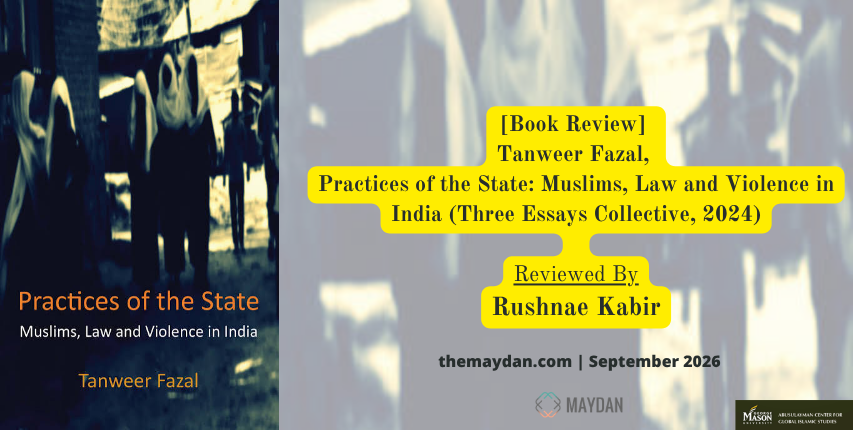
Since 2014, substantial ink has been spilled on chronicling, explaining, and contesting the Bharatiya Janata Party (BJP)’s predominance in national politics in India. Scholars have studied the ever-intensifying waves of anti-minority violence in the country, with a view towards understanding the structural causes that have enabled it. Much of this work has approached the issue through the frameworks of majoritarianism, democratic backsliding, or the erosion of the “idea of India,” i.e., the commitment to a secular, pluralistic and democratic state. Tanweer Fazal’s monograph, Practices of the State: Muslims, Law and Violence in India, contributes to this growing body of work, while departing from the axioms of prior scholarship in significant ways.
Rather than treat the present as a rupture or exceptional moment, Fazal shifts attention to the longer histories and everyday practices through which the Indian State has simultaneously produced and managed Muslim difference. His work challenges underlying assumptions about the relationship between law, state power, and minority life in India. Furthermore, his study of the public sphere and the nation-state more generally, offers a much-needed corrective to universalizing theories drawn from the American and/or European context. His work is therefore an extremely productive source not just for scholars of India, but all those who seek to decenter the “West” in dominant theoretical frameworks.
Tanweer Fazal does not treat the modern Indian State as one which emerged fully formed in 1947. Rather, he pays careful attention to how colonial legacies of administration, and principles of the Independence Movement came together to produce the idea of an independent Indian government. He shows how colonial modes of government, like administrative classifications of communities, legal reasoning, and practices of surveillance, were reworked rather than dismantled in the transition to independence. While he acknowledges the BJP’s victory in the 2019 general elections as a “watershed moment” (1) for Indian politics, Fazal’s sensitivity to historical context produces a deeper, more nuanced study of communalism in India, one which convincingly draws the connections between contemporary acts of violence and critical moments of the past, such as the 1989 Bhagalpur Riots, and even colonial-era legislation on cow slaughter.
Rather than focus on what the philosopher Giorgio Agamben called “states of exception” (in other words, moments of crisis that allow the State to claim emergency powers and suspend the ‘rule of law’), this book draws attention to the everyday interactions of Muslims with State authority. Through a number of case studies, Fazal shows how both everyday and extraordinary situations trigger identical responses from the police and legal apparatus when it comes to Muslims. By doing so, he effectively establishes that the marginalization of Muslims is embedded in the quotidian functioning of legal and bureaucratic institutions in India, rather than a by-product of exceptional instances.
Finally, rather than treat the State as distinct from society, Fazal emphasizes the constant interaction of the State and the national public. He identifies the State’s practices as the result of a triadic relationship, namely “state-dominant public-margin” (18). His approach offers a much-needed corrective to Habermasian theories of the public sphere, which presume that civil society lies outside of legal and political institutions
. By foregrounding their entanglement, Fazal illustrates that State practices are imbricated in what he terms “the epistemological production of the unruly margin” (17), a process through which Muslims (along with other marginalized communities) have been systemically marked as the Other of the dominant national public.
As a political sociologist, Tanweer Fazal brings attention to the quotidian together with a historical method. His primary archive comprises documents produced by the State itself, such as judicial orders, records of court cases, commissions of enquiries, and First Information Reports (i.e., incident reports filed by the police). Rather than approach them uncritically, he adopts an “against-the-grain” reading that allows him to “contrast the official truth as against that lived by communities” (21). The book is structured as five essays on various themes that have dominated contemporary discourse in India, tied together by their focus on the modern State and its practices which have produced a singular idea of the Muslim subject.
Chapter One studies with anti-immigrant politics in Assam, particularly in the context of the National Register of Citizens (NRC) and the Citizenship Amendment Act (2019). The NRC is a government list intended to identify ‘legal’ citizens of India by requiring individuals to prove their citizenship through documentary evidence. It was first instituted in the state of Assam, which shares its borders with Bangladesh (then East Pakistan) in 1951. An updating exercise was started in 2013, resulting in a final list in 2019 that excluded nearly 4 million people from citizenship status. When coupled with the Citizenship Amendment Act of 2019, which fast-tracks Indian citizenship for specifically non-Muslim migrants from neighbouring countries, this exercise disproportionately rendered Muslims vulnerable to the loss of citizenship rights. The passage of the Act triggered one of the largest mass protests the country has seen in recent decades in 2019, which were able to successfully limit the application of these twin measures over the whole country. However, the NRC exercise had already been carried out the state of Assam, triggered by decades-long agitations against “Bangladeshi influx” (47).
Tracing the history of anti-immigrant sentiment in Assam, Fazal discusses how the figure of the “illegal Bangladeshi infiltrator” (58) has been produced by the State’s legal instruments and practices, beginning as early as the years immediately after the Partition of the country. Central to this process is the State’s reliance on documentary regimes of citizenship, which place the burden of proof on individuals to establish belonging through often-fragile or inaccessible records. In practice, this has rendered large sections of a linguistically, ethnically, and religiously diverse population vulnerable to exclusion. Through a close reading of bureaucratic procedures and legal classifications, Fazal demonstrates how these mechanisms do not merely identify “outsiders,” but actively produce them, stripping individuals of political and civic rights while recasting them as threats to the integrity of the national body.
Chapter Two deals with beef politics and related vigilante violence in contemporary India. Identifying three landmark judgments on this issue, beginning from the late nineteenth century, Fazal maps how “the legal and the extra-legal, the executive and the judiciary, the religious and the secular” come together for “endorsing, enduring and at times even contributing to a hegemonic narrative in favor of cow protection” (63). Fazal points out that contrary to popular belief, beef consumption is neither religiously important for Muslims, nor an exclusively Muslim practice in India. At the same time, he acknowledges that discourses on cow protection remain “purposefully ignorant of the association of beef trade and its consumption with the livelihood and dietary practices of certain castes and communities” (63), most of which are marginalized in contemporary India. In doing so, he identifies the crucial role cow politics has played in producing a modern Hindu consciousness. Though self-avowedly about the making of a Muslim identity, this chapter shows that Fazal’s work does far more than that. It is equally about the making of a modern Hindu identity, one often defined in contrast to Muslims.
This perspective is deepened by Chapter Five, which studies the promulgation of the Scheduled Caste Order 1950. The order limited the application of Scheduled Caste status to those who had converted to Islam or Christianity. Curiously, Sikh and Buddhist lower castes were granted SC status and its attendant benefits, on the grounds that an “expansive” (164) definition of Hinduism included all Indic religions. Fazal’s argument here echoes that of C.S. Adcock’s influential text, The Limits of Tolerance, which argues that the fear of conversion is closely related to the fear of a denuding Hindu numerical majority in the country.
Chapter Three is the only chapter which looks at an extra-ordinary moment in the State’s practices, namely the Bhagalpur Riots of 1989. Fazal argues that in the aftermath of exceptional violence, the State seeks to regain its legitimacy by establishing special institutions for the pursuit of justice. Yet, as his close reading of judicial and administrative documents, and officially authored investigative reports show, these are merely strategies used by the State to invisibilize its partisan role in moments of violence.
Chapter Four studies the judicial proceedings in the early twentieth century Shahidganj Mosque case, in which a long-standing dispute between Muslim and Sikh claimants to the site of the mosque was adjudicated in favor of the latter. Rather than treating the judgement as an isolated colonial-era decision, Fazal reads it as a key moment in the formation of a legal logic that privileges “non-interference and status quo” (136). In doing so, the case establishes a precedent through which the erosion of Muslim claims can be rendered gradual and legally intelligible.
Fazal’s exploration of this case expertly offers a mirror to the Ayodhya-Babri Masjid issue, whose specter looms large in Indian politics even after the inauguration of the Ram Temple in 2024. As other mosques and Muslim religious sites come under increasing attack, this chapter proves extremely useful in identifying the legal principles and tools the State uses to make its claim. It shows how claims to legal neutrality and an ostensible commitment to preserving religious sentiment and public order may be operationalized to render some claims inferior to others. Taken together, these chapters masterfully deconstruct the institutional, legal, and political mechanisms involved in producing the image of the marginal Muslim, an image which flattens much of the diversity and heterogeneity within the community.
If 2019 was a watershed, what of 2024? While the BJP won its third consecutive national election last year, the changes in voting patterns and a comparatively lower seat share for the party was cause for hope for those unhappy with its divisive politics. Yet, as the persistence of both legal and extra-legal violence against minorities makes clear, electoral developments have done little to alter the deeper structures through which marginalization is produced. It is precisely here that Fazal’s intervention proves most valuable. By shifting attention away from moments of rupture to the longue durée of state practice, he compels us to reconsider the relationship between law, violence, and legitimacy in contemporary India.
His analysis suggests that the problem is not reducible to a particular political regime or party, but has its foundations in institutional logics that long predate the present and continue to shape it. In this sense, Practices of the State is not only a study of Muslim marginalization, but a broader reflection on how the modern State produces difference through the very mechanisms that claim to govern it impartially.
Rushnae Kabir is a PhD Candidate at the Department of Religious Studies at the University of Pennsylvania. She specialises in the study of print culture and South Asian Islam.